
Trapped Intelligence
Drowning in the culture of omnipresent screens

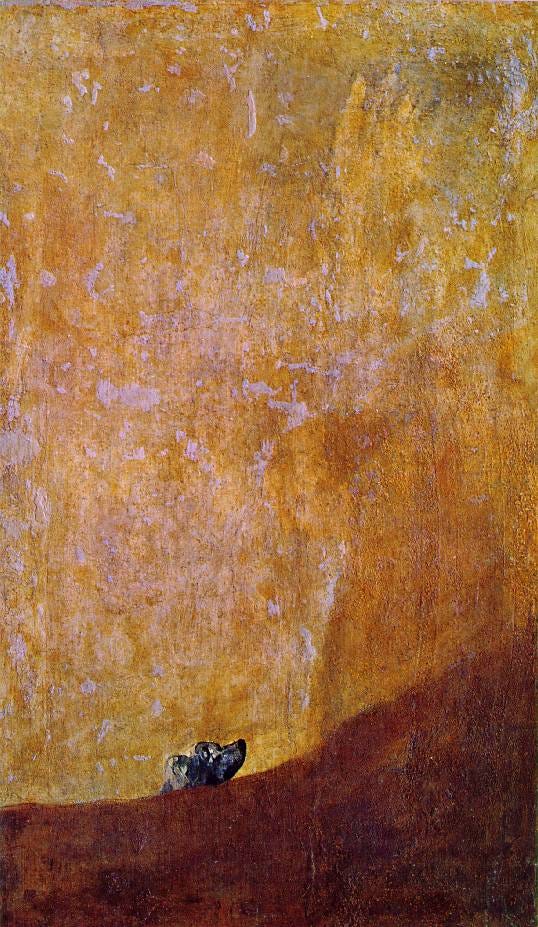
Francisco de Goya painted this picture on the wall of his house, Quinta del Sordo (the Villa of the Deaf). At the time he was suffering from the poor condition of his physical and mental health. This picture, El perro, is one of the fourteen pictures from "The Black Paintings," very dark and frightening works of the artist. In the picture, the dog is trapped in something that seems to be mud or swamp. Fear, hopelessness, and desperation can be seen in its eyes. We can't see any rescue coming. Only mud everywhere and the head of the poor dog.
As I am reflecting on the condition of our minds, that dog reminds me of my own. I'll explain what I mean. And I'm going to be as honest with you as I can here. Because pretending that everything is alright when it's not is a bad idea.
So, what do I have? I am 34 years old. I am tired every day. My life is very busy; I am sure you can relate here (most people are very busy these days). My husband and I have two kids (10 and 6 years old) and a dog. I also work. I go to church. Serve in church. Every day I have to do tons of things to sustain the rhythm of this life. I'm telling you all of this so you can see the picture of what kind of life I am writing this from (it will be important further for our story).
Now, there's also a very important detail in the puzzle:
I scroll.
Instagram mostly (that's because I'm a millennial, I guess).
*Hold on, hold on. If any of you have never doom scrolled, then go ahead and throw the first stone at me, alright?
Whenever my brain has a spare minute, it thinks it needs a stimulus. So it reaches for the familiar quick dopamine hit. Click, scroll, click, scroll, and I haven't noticed how I spent half an hour on total trash. As if social media hypnotizes me or something. Classic screen addiction is on the display, ladies and gentlemen.
I have a long history of wrestling with my phone and social media in particular. I fasted from Instagram several years ago after I had read Digital Minimalism by Cal Newport (spoiler: it was one of the best months in my life), I tried to use my willpower to set some limits on how much I use social media, and I deleted Instagram from my phone several times. All these things worked for quite a time, but then I returned to the starting point: click, scroll, click, scroll. Scroll-scroll-scroll...
But why is it a problem?
I'll tell you.
One: my attention span. It has shrunk significantly. How do I know that? Books. I have a hard time reading books (and I am a book lover!), for while reading them, I have intrusive thoughts about social media! I have this weird urge to check on Instagram, even if I don't have any particular reason for that. And at the same time my brain is yelling, "This long train of thought is suffocating, give me my usual click-scroll, I'm tired!" Instead of being something really fun, reading becomes a labor.
Two: it's hard to write a text longer than a typical long Insta caption. It's pretty logical and obvious that what I consume I reproduce. As social media is an incoherent flow of absolutely random short videos and posts, it creates chaos in my brain. A writer who cannot write—here we go.
In other words, I am becoming stupid intellectually simple.
But that's not the end of the problems.
Three: I don't really rest. While scrolling I get some feeling of relief from stress and the business of life, but in reality it turns out I just overload and overstimulate my brain. As if this type of activity drains out my nervous system. After spending a significant amount of aimless time on social media, I don't feel refreshed and ready to live my life. On the contrary, I am still tired, plus I wasted my time. Again.
Four: I can't be completely present with my family. Kids, especially small kids, are truly alive. They require your undivided attention; they need a fully present parent, not the phone-glued shell of a person. And focusing on meaningful time with kids becomes hard, because it doesn't provide you (me in this case) with the quick dopamine hits. Ugly, I know.
Now here's the thing: I was born in 1991, the pre-smartphone era. I was raised among books. Lots of real physical books. I remember them being piled on my father's desk and bookshelves. His books were about physics, advanced math, and fractals (and who knows what other kind of science was there). I remember different Russian and German dictionaries of my mother—explanatory, etymological, spelling, and phonetic dictionaries. I learned to read early, and I genuinely enjoyed it as a child. I read tales, adventure stories, detective stories, and fantasy (Tolkien and Lewis were part of the diet, of course). Books were not gymnastics for my brain; they were my main leisure activity.
How did I get here? How did I switch from a life of books, deep thoughts, and rich imagination to this stupid shallow click-scroll? I think the same way it happened to many of us: we didn't think. The new shiny thingies appeared, and we just embraced them with childlike curiosity and excitement. We didn't ask questions. We didn't suspect any dirty tricks.
Over time smartphones got more and more sophisticated. And we grew more and more dependent on them. They became little computers in our pockets, freeing us from bulky PCs. We could search the Net whenever and wherever we wanted, we could stay in touch with friends, and we could listen to music. Then, like a true black hole, a smartphone started to devour little short of every aspect of our lives: it became our TV, our radio, our notebook, our camera, our photo album, our library, our workspace, and, eventually, with the rise of social media as we know it today, our entertainment and social life. Bit by bit, step by step, we allowed a smartphone to become a central thing in our lives. All in the name of convenience, speed, and productivity.
That's how the dog got stuck in the mud of omnipresent screens.
You think I'm exaggerating here? Maybe I am. And maybe I am not. How many hours can you spend without even thinking and knowing where your phone is? Do you take your phone with you wherever you go? Do you experience strong anxiety if you suddenly can't find your phone? Is the social media in your phone the first thing you reach for when you feel bored? Look, I think you know the answers. And I know them, too. We all are hooked.
*In case this is not about you, then, Mr. Anderson, I'm genuinely proud of you, because you broke free from the matrix, and you bow to no one.
Why?
Why do we continue doing the things that hurt us even if we know they cause the damage? This is a very complex issue. And I don't claim to be an expert in the addiction topic. But one of the reasons, in my opinion, is that somehow we still benefit from those harmful things.
I draw my conclusions from my own experience. For example, when I scroll, I have this illusion of being among people; on the contrary, while I am reading a book, I am alone (okay, some books feel like I am listening to the author talking to me, but this quiet deep conversation cannot stand the comparison to the noisy social media party).
For a brain fried on overuse of screens, real life looks very overwhelming, monotonous, and boring. While scrolling I give my brain these short dopamine hits; the brain's happy, and I feel relieved from stress (remember, I described my busy life in the beginning?). Click-scroll is a way to escape that reality pressure. But the effect doesn't last long, and real life doesn't provide me with the cheap dopamine, so I come back for more of it to screens and social media particularly. The cycle goes on and on.
This article is not about me telling you what to do with the screen addiction. It's more about me telling myself that enough is enough. I just want 2026 to be the year when I reclaim my intelligence. Maybe there was no hope for the poor Goya's dog, but I don't want this to be the reality for my mind. I don't want to wake up one day and realize (if there are still brain cells left for analytical thinking) that screens and social media dumbed me down and I can't produce anything coherent, be that text or speech. I want this year to be a year of books, writing, and art. A year of creating, instead of aimless consuming. I wish more and more people gave up social media as a main thing for fun and numbing stress.
If you were looking for a sign to make some changes in your life, here it is: stop scrolling, go create something. And never look back.
Maria, you raised an important issue in your post that we’re all familiar with to some degree.
I fall into doom scrolling sometimes too. As for books, I read a ton in the ’90s and early 2000s, but now I can hardly read fiction anymore. Probably partly because I read so much non-fiction, and partly because of social media.
I really liked your solution of declaring this year the year of books and art. It feels like it’s really good decision and I need to do the same.
Reading your article brought to mind Paul's words about doing what he didn't want to do, and not doing what he wanted to do. We could all stand to step away from social media a little more. Good words.