
Thinker's Sanity Stack | Vol. 1
March 2025


We need more books. These days especially. As we are more and more making the Internet our main source of information (often it's shrunk to social media only), the depth of our knowledge and intelligence is decreasing. And we are poor readers these days, too. The Internet has taught us to consume information in small, unrelated bits. We struggle to stay focused on any long read. This is not okay. And this is not happening just to those people who never read books. This is happening to avid readers, myself included. I believe that returning to books as our main source of information (or, at least, including books and long articles into our informational diet) can be a remedy against shallow thinking.
With that said, how about establishing a tradition here, guys? I'm going to publish a Thinker's Sanity Stack post once a month or once in two months with a fresh stack of books & articles I do recommend. Those are the books and long reads I know, which means I have read them or I am in the process of reading them now. I’m going to cover different categories: some stuff for character formation (it can include faith books (I am Christian; there will be faith books, for sure) or philosophy stuff), books on technology, of course, fiction, poetry, and history books. The Sanity Stack will include short reviews for each recommendation, the quotes I personally find relevant, and links to the places the books can be bought. In turn, you will tell me what you think of my recommendations, or you'll share with us your read for the given month in comments. Let's cure our fragmented attention and give that brain some heavy lifting.
So, here's what we've got for March.
1. Man’s search for meaning by Viktor Frankl
“Everything can be taken from a man but one thing: the last of the human freedoms—to choose one’s attitude in any given set of circumstances, to choose one’s own way.”
There are books and stories that make us better people. “Man’s Search for Meaning” is exactly that kind of book. Viktor Frankl, the author, was an Austrian psychiatrist and psychotherapist who survived Nazi concentration camps. Viktor Frankl developed logotherapy, a psychological approach based on the idea that the main motivation of a person is the search for meaning in life (in contrast to Sigmund Freud, for example, who proposed that the main motivation of a person was the search for pleasure). In the horror of the concentration camp, his ideas were tested and tried not just in real life but in real hell on earth. He witnessed and lived the circumstances most of us will never face: people in those camps were dehumanized and stripped of freedom. There, amidst degradation and total loss of hope, the people who had meaning in their lives and held onto it were more likely to survive. In “Man’s Search for Meaning,” Viktor Frankl tells us the story of hope.
Here are some quotes from “Man’s Search for Meaning.” Put them into the context of what the author went through, and you most probably will be inspired and uplifted.
Everything can be taken from a man but one thing: the last of the human freedoms—to choose one’s attitude in any given set of circumstances, to choose one’s own way.
Man does not simply exist but always decides what his existence will be, what he will become the next moment. By the same token, every human being has the freedom to change at any instant.
Dostoevski said once, "There is only one thing I dread: not to be worthy of my sufferings." These words frequently came to my mind after I became acquainted with those martyrs whose behavior in camp, whose suffering and death, bore witness to the fact that the last inner freedom cannot be lost. It can be said that they were worthy of the their sufferings; the way they bore their suffering was a genuine inner achievement. It is this spiritual freedom—which cannot be taken away—that makes life meaningful and purposeful.
Even though conditions such as lack of sleep, insufficient food and various mental stresses may suggest that the inmates were bound to react in certain ways, in the final analysis it becomes clear that the sort of person the prisoner became was the result of an inner decision, and not the result of camp influences alone.
The crowning experience of all, for the homecoming man, is the wonderful feeling that, after all he has suffered, there is nothing he needs to fear anymore—except his God.
2. Experience Jesus. Really by John Eldredge
“My concern is that our faculty of faith - the ability to trust and believe - has been secretly eroded by something most of us are completely unaware of.”
Is there a discussion on how to be a Christian in our digital artificial age going on right now? Sign me up! “Experience Jesus. Really” got released this month. I am reading it now, and here’s what I can tell you so far: The author (John Eldredge is a Christian therapist and a writer; if you are not familiar with him, I strongly recommend you read his other books as well, starting with “Wild at Heart”) talks about faith in our age of technology, how it’s being affected by our modern life of speed and ceaseless distraction, and what we can do to protect our faith and our hearts at such a time as this. Though I haven’t read the whole book yet, I’ve included it in this March Stack because the topic resonates with me a lot.
Look at the quotes, guys:
My concern is that our faculty of faith - the ability to trust and believe - has been secretly eroded by something most of us are completely unaware of. It has to do with the fact that we are, all of us, Desciples of the Internet. If that seems unfair, if you repel the idea that you might be a Desciple of the Internet, consider this: You are a desciple of the system that tutors you, where you turn on a daily basis for guidance on living.
Descipleship to the Internet has shaped your soul to expect immediate answers to your questions; given you a deep suspicion to all forms of mystery; fueled your addiction that the “practical” is the real stuff of life; while eroding your confidence that you can know anything for certain because yesterday’s facts are savagely overturned. We are all worn out from this way of operating in the world, because there is no life in it.
The developed world with all its comforts, resources and technologies has lulled us into thinking that our safety is found in where we live, in public services, in our medical coverage and retirement plans. But we’re especially convinced that knowing the right facts and techniques will secure our lives, so we scramble to make sure we have the latest science, the irrefutable data - only to have them overturned the next day. This double bind has made skeptics of us all - increasingly anxious skeptics.
3. The Shallows: What the Internet Is Doing to Our Brains by Nicholas Carr
What we’re experiencing is, in a metaphorical sense, a reversal of the early trajectory of civilization: we are evolving from being cultivators of personal knowledge to being hunters and gatherers in the electronic data forest.
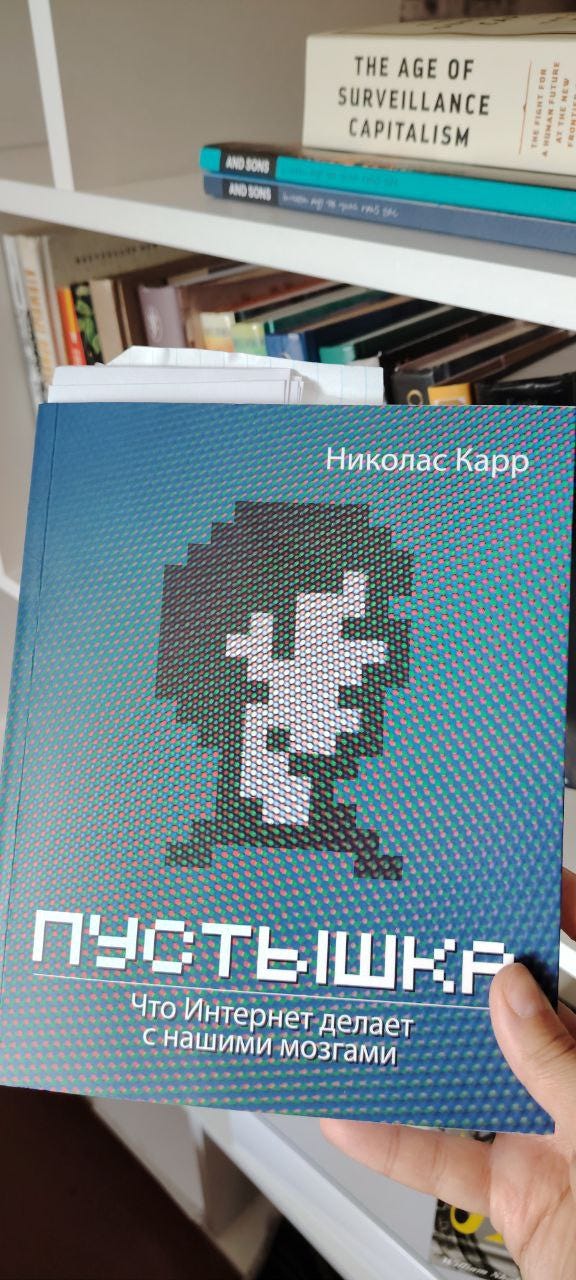
This book was first published in 2010, and I’ve got the translated into Russian language copy of 2012. But the link provided here is to the updated English version released in 2020.
“The Shallows" is great if you only begin diving into the topic of the influence the Internet has on our lives. It's the perfect starting point because it gives you a general idea of our cultural moment in terms of technology. It explains how the human race is being formed by technologies (humanity experienced dramatic change every time new technology emerged: think about writing, a clock, or a map; and now it's the Internet and digits) and how our brains are being altered (physically) by digital technology so that we are losing our ability to read and think deeply, for example. Reduced attention span, shallow thinking, screen-glued life… what a time to be alive! Here are some quotes:
What we’re experiencing is, in a metaphorical sense, a reversal of the early trajectory of civilization: we are evolving from being cultivators of personal knowledge to being hunters and gatherers in the electronic data forest.
The Net’s interactivity gives us powerful new tools for finding information, expressing ourselves, and conversing with others. It also turns us into lab rats constantly pressing levers to get tiny pellets of social or intellectual nourishment.
What the Net seems to be doing is chipping away my capacity for concentration and contemplation. Whether I’m online or not, my mind now expects to take in information the way the Net distributes it: in a swiftly moving stream of particles. Once I was a scuba diver in the sea of words. Now I zip along the surface like a guy on a Jet Ski.
In the quiet spaces opened up by the prolonged, undistracted reading of a book, people made their own associations, drew their own inferences and analogies, fostered their own ideas. They thought deeply as they read deeply.
Now, the last, but not the least…
4. The Lion, the Witch and the Wardrobe by C. S. Lewis
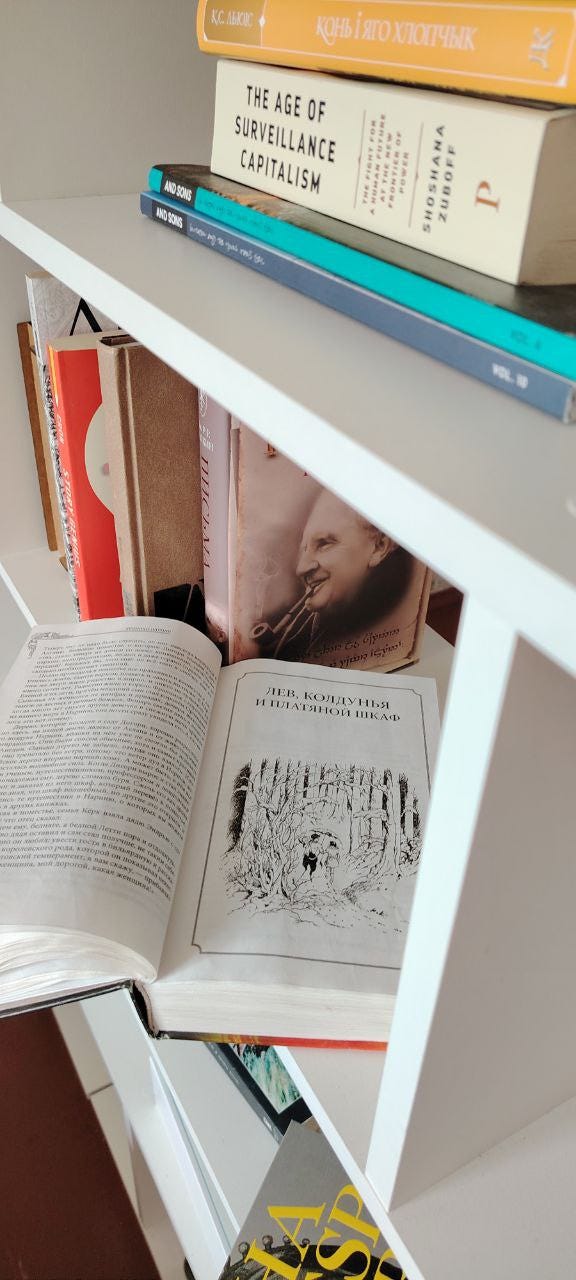
Why? Because it's March, spring has come. And Aslan is on the move.
!
Wrong will be right, when Aslan comes in sight,
At the sound of his roar, sorrows will be no more,
When he bares his teeth, winter meets its death,
And when he shakes his mane, we shall have spring again.
Most probably you are acquainted with the Chronicles of Narnia series. In case you are not, friends, please go read it; it will enrich your mental life. It's a tale, yes, but it's not only for kids, believe me. As any really good tale, The Chronicles of Narnia speaks to adults as well.
“They say Aslan is on the move- perhaps has already landed."
And now a very curious thing happened. None of the children knew who Aslan was any more than you do; but the moment the Beaver had spoken these words everyone felt quite different. Perhaps it has sometimes happened to you in a dream that someone says something which you don't understand but in the dream it feels as if it has some enormous meaning- either a terrifying one which turns the whole dream into a nightmare or else a lovely meaning too lovely to put into words, which makes the dream so beautiful that you remember it all your life and are always wishing you could get into that dream again. It was like that now. At the name of Aslan each one of the children felt something jump in its inside. Edmund felt a sensation of mysterious horror. Peter felt suddenly brave and adventurous. Susan felt as if some delicious smell or some delightful strain of music had just floated by her. And Lucy got the feeling you have when you wake up in the morning and realize that it is the beginning of the holidays or the beginning of summer.
“Aslan is a lion- the Lion, the great Lion." "Ooh" said Susan. "I'd thought he was a man. Is he-quite safe? I shall feel rather nervous about meeting a lion"..."Safe?" said Mr Beaver ..."Who said anything about safe? 'Course he isn't safe. But he's good. He's the King, I tell you.”
If there's anyone who can appear before Aslan without their knees knocking, they're either braver than most, or else just silly.
That's it; that’s enough for now. I'll return with the new portion in a while, and I hope you guys will read more this spring.
Read more, scroll less.
Maria
I love this list! They are all books I love or plan to read. I agree that we need to cling to the habit of reading books and training our brains to pay attention. I just finished God of the Garden by Andrew Peterson and loved it. I felt so understood in my craft as a writer and the doubts we face. Now I am reading Everything Sad Is Untrue. The point of view as an immigrant boy comparing his childhood home in Iran with his new home in America is gripping emotionally and artistically. So well written. I look forward to your next set of recommendations!
Great reading list, Maria!! Frankl’s book has deeply impacted me. And I’ve really wanted to read the new Elredge book so thank you for sharing those powerful quotes!!